Kabila's New Power Structure: Who Are the Leaders of the FRN?
AfroQast Team
October 16, 2026
Kabila's New Power Structure: Who Are the Leaders of the FRN?
GOMA, DR CONGO — October 15, 2026
The Democratic Republic of Congo has entered a new phase of political confrontation following the announcement of the **Front for the Refoundation of the Nation (FRN)**, a political-military movement led by former President Joseph Kabila.
Established on October 12, 2026, in Goma, the new coalition brings together influential figures from the former Congo River Alliance (AFC) and the M23 rebellion, creating a leadership structure that combines political experience, rebel organization and military command.
The FRN has declared its intention to challenge President Félix Tshisekedi's government, including through the possible use of force.
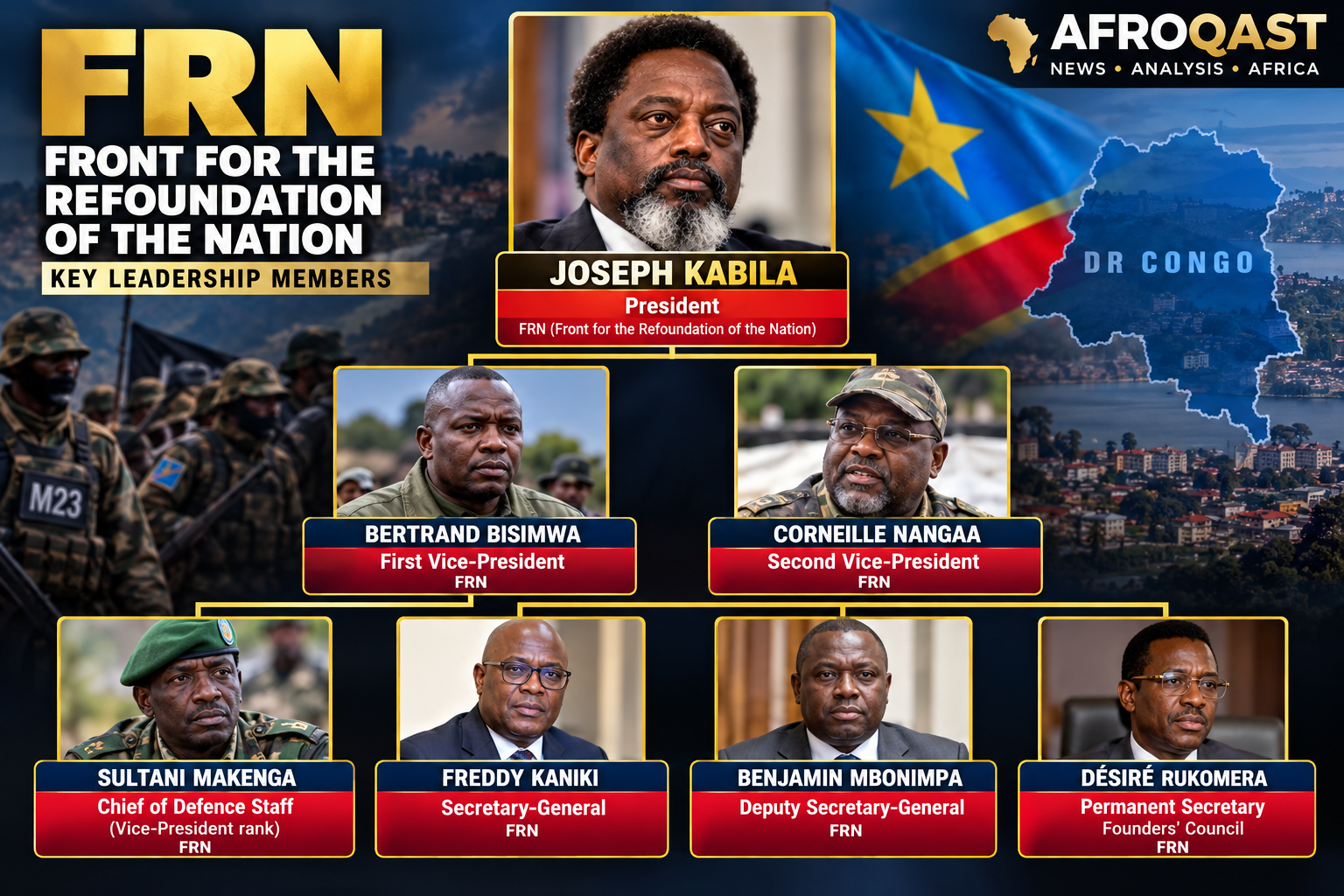
Joseph Kabila — President
At the top of the organization stands Joseph Kabila, who governed DR Congo from 2001 to 2019.
His appointment marks a dramatic political comeback. After years of rivalry with his successor, Kabila now leads a movement that includes armed groups fighting the Congolese government.
His position gives the coalition a former head of state with extensive political experience and connections.
Bertrand Bisimwa — First Vice-President
Bertrand Bisimwa, a prominent political leader of the M23 rebellion, occupies the first vice-presidency in several published leadership lists.
His inclusion connects the new movement to the M23's established political organization and its influence in eastern Congo.
Corneille Nangaa — Second Vice-President
Corneille Nangaa, formerly president of Congo's Independent National Electoral Commission, became a leading figure in the AFC coalition.
His appointment places an experienced political organizer alongside Kabila and Bisimwa.
Together, the three represent the central political leadership of the newly established front.
Major General Sultani Makenga — Military Chief
Major General Emmanuel Sultani Makenga retains responsibility for the military command associated with the movement.
He serves as Chief of General Staff of the Congolese Revolutionary Army, with vice-presidential rank under the FRN's founding declaration.
His position makes him one of the most significant military figures within the coalition.
Professor Freddy Kaniki — Secretary-General
Professor Freddy Rukema Kaniki has been appointed Secretary-General and Coordinator of the Executive Committee.
His role involves coordinating the movement's administrative and organizational leadership.
Benjamin Mbonimpa — Deputy Secretary-General
Benjamin Mbonimpa serves as Deputy Secretary-General and Deputy Coordinator of the Executive Committee.
Previously involved in the AFC/M23 peace negotiations, his appointment gives the new organization a figure familiar with diplomatic discussions.
Désiré Rukomera — Permanent Secretary of the Founders' Council
Désiré Rukomera Rwigema has been appointed Permanent Secretary of the College of Founders.
His position is associated with the movement's founding institutional structure.
What Does the FRN Want?
According to its founding declaration, the FRN aims to challenge what it describes as political repression, corruption, institutional decline and insecurity under President Tshisekedi.
The coalition promises national reconciliation, institutional reform, better governance and more equitable management of Congo's resources.
These are the movement's stated objectives, not independently established assessments of the government's conduct.
The coalition has also declared its willingness to use force, raising concerns about the possibility of further violence.
What Happens to the Peace Process?
The creation of the FRN introduces uncertainty into the negotiations involving the Congolese government and AFC/M23 representatives.
Although the FRN declaration announces the dissolution of the AFC political structure, the future of existing military organizations and peace commitments remains unclear.
The leadership restructuring could influence negotiations, military operations and regional diplomacy.
For civilians in eastern Congo, where years of fighting have caused widespread displacement and humanitarian suffering, the consequences could be significant.
A New Political Chapter for DR Congo
The creation of the FRN brings together Joseph Kabila's political experience, established rebel leadership and military command under a single announced structure.
Whether this coalition becomes a lasting political force, intensifies armed confrontation or changes the direction of peace negotiations remains uncertain.
For Congo, the central question is whether this new alliance will deepen the country's conflict or create another opportunity for a negotiated political settlement.
AFROQAST — African Voices. African Stories. Global Conversations.